Welcome to Sourdough Ho: Flour, Fermentation & Chaos
There’s usually flour on my counter. Sometimes on the floor. Occasionally on a child.
The kitchen is loud, messy, chaotic, and very much lived in — because this is a home, not a studio set. And honestly? I think that’s exactly how it should be.
About Me (and Why I’m Here Rambling About Bread)
I’m a mom to one, stepmom to two, co-owner of multiple businesses, and someone who somehow decided that adding sourdough baking into the mix sounded relaxing.
I know how that sounds.
But here’s the thing: it actually kind of is.
When you’re juggling client calls, school pickups, household logistics, managing teams, handling spreadsheets, and the general chaos that comes with blended family life, there’s something genuinely grounding about sourdough. It’s not relaxing in the way that, say, a spa day is relaxing. It’s more like the kind of relaxation that comes from doing something with your hands, something tangible, something that has clear steps and visible progress.
Maybe it’s the fact that there’s a built-in waiting period between steps — you can’t rush from one phase to the next without disrupting the entire process. Maybe it’s that sourdough fermentation demands that you slow down. You have to check your dough. You have to feel it. You have to develop an intuition for what it needs. You can’t just set a timer and walk away; the dough will let you know if you tried.
Or maybe it’s simply that when everything else feels completely out of control — business decisions, family dynamics, school schedules, the general overwhelming nature of adulting — creating something tangible and delicious with your hands feels like a small rebellion against the chaos. Like you took all that chaotic energy and turned it into a crusty, beautiful loaf of bread.
Somewhere between the stretch-and-folds, bubbling starter jars, and loaves that definitely didn’t go as planned, sourdough became one of my favorite parts of the day.
Not because it’s perfect. But because it isn’t.
The Real Magic: Baking With My Son
Some of my favorite kitchen moments involve my son. He hangs out while I’m mixing doughs, stretching, folding, shaping — asking questions, showing me toys, and generally being wonderfully, authentically chaotic in a way that most polished kitchen content pretends doesn’t happen.
Here’s something that doesn’t get talked about enough in the baking community: my son has Childhood Apraxia of Speech (CAS), and baking together has become so much more than just making bread. It’s time spent learning, practicing speech, talking through steps, counting ingredients, and building confidence in a low-pressure environment.
When we’re baking, he’s not just watching. He’s participating in a structured activity that naturally incorporates speech practice. He’s telling me which ingredient comes next, counting scoops of flour, repeating words like “fold” and “stretch” and “ferment.” He’s problem-solving (“Mom, is this dough supposed to look squishy?”) and following multi-step directions. He’s learning about cause and effect — if we fold here, the dough develops differently than if we fold over there.
And he’s doing all of this in an environment where making mistakes — where the dough overproofs or the shaping goes wonky — is completely normal and honestly kind of the point. There’s no judgment. There’s no “you did it wrong.” There’s just “huh, that’s interesting, let’s see what happens.”
Yes, we’re also simultaneously discussing dinosaurs, monster trucks, or whatever else has captured his attention that week. Yes, the counter might have flour in places flour has no business being. Yes, measuring anything becomes an adventure when tiny hands want to help. Yes, sometimes we have to take a break mid-fold because he needs to show me something he drew or tell me about something that happened at school.
But those are my favorite moments. The ones that don’t make it onto the perfectly lit, carefully styled cooking blogs. The ones that are actually where the real magic happens — not just in the bread, but in the time spent together, the confidence building, the communication practice wrapped up in the simple act of making something together.
How This Whole Thing Started
This whole sourdough journey began with something beautifully simple: someone in my local Buy Nothing group offered dehydrated sourdough starter for free.
I’d always wanted to try making sourdough. I’d watched the videos, saved the tutorials, bookmarked the blogs. But like so many things in life, I was waiting for the “right time” to start. The right time to take on a new hobby. The right time when things were less busy. The right time when I had more mental energy. The right time when the kitchen wasn’t in complete disarray.
Spoiler alert: the right time is never going to naturally appear on your calendar, fully formed and convenient. So when this offer showed up in my Buy Nothing notifications, I figured the universe was basically saying, “Hey, stop thinking about it and actually do it.”
I responded to that post. I picked up the starter. And I started baking.
That was months ago, and I’m honestly still a little amazed at how much bread one person can bake before developing a genuine concern about maintaining the health of a sourdough culture. Because yes, I’ve become the kind of person who worries about maintaining a sourdough bloodline. I actually dehydrated some of my own starter as backup, which felt like a very significant moment — like I was taking this seriously now, like I had moved from “curious beginner” to “person who has Plans for this hobby.”
(I’ll probably share that whole process soon because rehydrating dehydrated starter is actually pretty fascinating, and surprisingly easy. If past-me had known how manageable it was, I wouldn’t have spent three days panicking about the “what ifs” and worrying that I’d kill my starter. Spoiler: it’s much harder to kill than you think.)
Getting Started (The Kit That Actually Helps)
For anyone thinking about jumping into sourdough but feeling overwhelmed by where to begin — and there is a lot to feel overwhelmed by, let’s be honest — I started with this kit, and it genuinely made a difference in those early days.
The beautiful thing about having a starter kit is that it removes a certain amount of decision paralysis. There are so many tools available for sourdough baking. So many options. So many “you absolutely need this” recommendations that come from experienced bakers who have been doing this for years. But if you’re just starting out, trying to figure out what you actually need versus what’s nice-to-have can be paralyzing.
(This post may contain affiliate links, which means I may earn a small commission at no extra cost to you)
Did I need every single thing in the box? Probably not. Do I use everything regularly? Not quite. But it gave me a solid place to start without having to piece everything together individually while simultaneously researching whether I was buying the “right” tools. There’s already enough decision fatigue in baking without worrying if your banneton basket is the correct size or if you should have gone with a different brand of dough scraper.
I’m planning a future post breaking down what I actually use regularly, what I could live without, and what ended up being more helpful than expected. Because not all tools are created equal, and not all recommendations on the internet are actually useful for home bakers who are working in real kitchens (not test kitchens) with real constraints (like limited counter space, inconsistent kitchen temperatures, kids wandering through asking if the dough is ready yet, and the fact that sometimes you just have to work with what you’ve already got).
What You Can Expect Here
Around here, you can expect a pretty specific vibe. This isn’t a generic baking blog, and I’m not trying to become one:
Sourdough experiments — and I mean real experiments, not “I followed the recipe exactly and it turned out perfect” stories. I’m talking about times I tried something different because I was curious. Maybe I adjusted the hydration. Maybe I extended the bulk fermentation. Maybe I tried a different scoring pattern. Sometimes it works beautifully. Sometimes it becomes a learning experience (which is a nice way of saying “that was a disaster but we’re not throwing it out yet, and also I’m going to try to figure out where this went wrong”).
Beginner-friendly baking content — because I’m still figuring this out too. I’m not a professionally trained baker. I’m not running a commercial operation with a wood-fired oven and a perfectly climate-controlled space. I’m someone who decided that sourdough seemed interesting and then actually committed to the learning curve. Which means I remember what it felt like to not know what “autolyse” means or why starter strength matters or what the difference is between a stretch-and-fold and a lamination.
Realistic kitchen chaos — flour on unexpected surfaces (seriously, how does it get there?), interruptions mid-fold because someone needs something important right now, the exact techniques for working around a kid who has decided right this moment is the perfect time to need something. The reality that sometimes you’re shaping a loaf while also helping with homework. Sometimes the dough is bulk fermenting while you’re in a work call. Sometimes life and baking happen at the same time, and that’s just how it goes.
Starter troubleshooting — because starter problems are real and they’re frustrating, and sometimes you need to talk through what’s happening with someone who won’t tell you that you’re “clearly not feeding it right” with an implied eye roll. Sometimes your starter is sluggish. Sometimes it smells weird. Sometimes you’re not sure if it’s actually alive. These are all things I’ve experienced, and I’m here to talk through them.
Discard recipes — because once you commit to sourdough maintenance, you generate a lot of discard, and there are only so many pancakes and crackers one household can consume. I’ve been experimenting with everything from sourdough chocolate chip cookies to sourdough pizza dough to sourdough waffles to sourdough muffins, and I’ll be sharing what actually works and what was just kind of mediocre.
Honest failures — here’s what I’m not going to do: pretend that every loaf that comes out of my oven is Instagram-worthy. Because they’re not. Some loaves flop. Some spread instead of rise. Some look like they fought for their life in the oven and lost. Some have huge gaping holes when you cut into them (which apparently means they were overproofed, or hydrated too high, or some combination of factors I’m still learning about). Those are the ones I’m actually most interested in analyzing and understanding, because that’s where the real learning happens.
Small victories — but also the things that actually feel significant, like the first time a loaf scored exactly how you wanted, or when you finally understand the difference between a loaf that’s under-proofed versus one that’s over-proofed just by looking at it. Or when you successfully troubleshoot why your starter wasn’t active and actually fix it.
Baking with kids — the beautiful chaos of that, the learning opportunities, the mess, the moments where you’re stretching dough and simultaneously helping with homework, and why I think that’s actually better content than the sanitized, silent, adult-only version of baking.
Product reviews — honest ones. I’ll tell you what works, what doesn’t, whether something is worth the price or whether you can make do with what you’ve already got. Not everything needs to be replaced with expensive specialty equipment.
Flour-covered counters — yes, literally. This kitchen is lived in. There will be flour. There will be crumbs. There will be evidence of actual baking happening.
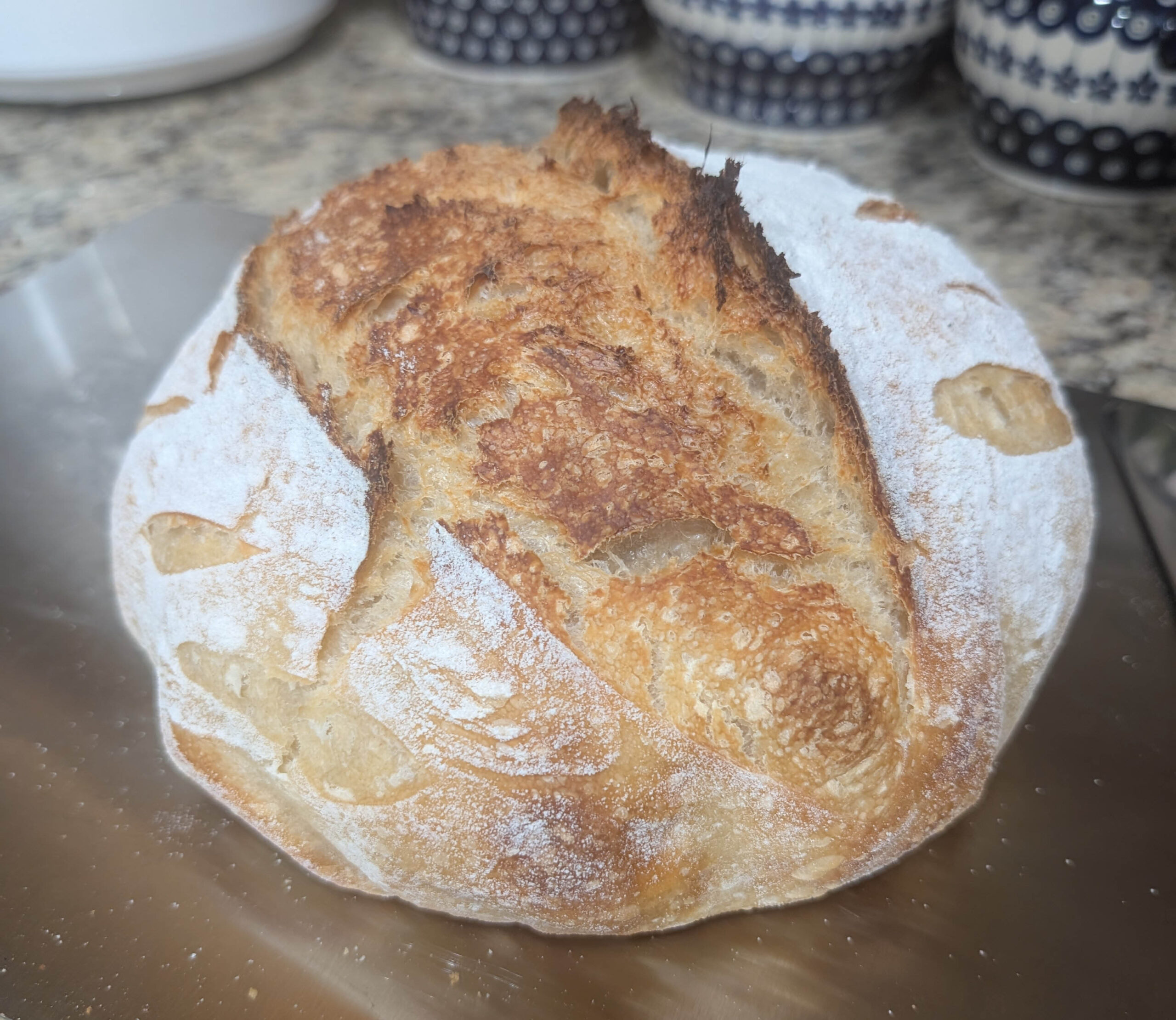
Way too many photos of bread — I’m obsessed with documenting the entire process, the crumb structure, the color, the way the light hits that scoring. Fair warning.
What This Blog Is NOT
This isn’t going to be one of those perfectly curated baking blogs where every loaf looks identical and the kitchen sparkles at all times. You won’t see styling props that have nothing to do with actual baking, or lighting setups that take three hours to achieve for a two-minute photo. You won’t see a kitchen that looks like a spread from a magazine.
Some loaves will flop. Some recipes will fail. Sometimes the dough will overproof while I’m answering work emails or helping with homework or taking a call with a business partner. Sometimes I’ll batch my baking in weird ways because that’s what actually fits into my life, not because it’s the “correct” way.
And that’s not a bug — it’s the point.
Why I’m Writing This (And Why It Matters)
There’s a lot of content out there about sourdough. There’s beautiful content. Perfect content. Intimidating content that makes you feel like you need to have your life completely organized and your kitchen completely clean and your timing completely precise in order to make bread.
There’s content that implies sourdough baking is this zen, meditative experience where everything goes perfectly and you emerge from the kitchen with beautiful loaves and a sense of calm.
But here’s what I think the world needs more of: honest content. Real content. The kind where someone shows you their actual kitchen on an actual day, tells you what actually worked and what didn’t, and doesn’t pretend that baking is this perfectly zen experience where nothing ever goes wrong.
Because baking is chaotic. Life is chaotic. And somehow, when you combine them — when you add sourdough to the mix of everything else you’re juggling — you end up with fresh bread and memories and a house that smells absolutely amazing.
Real life deserves fresh bread. Your imperfect kitchen deserves sourdough. Your “I don’t have this completely figured out” self is exactly the person who should be trying this.
Welcome
So welcome to Sourdough Ho: Flour, Fermentation & Chaos. I’m genuinely glad you’re here.
Thanks for stopping by, and I can’t wait to share this journey with you — flour splatters, failed experiments, tiny helping hands, small victories, and all.
Let’s make some bread together.
